The culinary programming of the Revel in its infancy caught Shreveport lightning in a bottle

by Chris Jay
stuffedandbusted at gmail dot com
The creation of this post was sponsored by a supporter of the Red River Revel Arts Festival
The first few years of the Red River Revel Arts Festival were unbelievably cool, in terms of culinary arts programming. The Revel, which is turning 50 in 2026, reliably boasts an outstanding assortment of food vendors. This isn’t their story, which also deserves to be told. This is the story of how the first few years of culinary arts programming at the Red River Revel captured lightning in a bottle by showcasing a group of chefs that included some of the most fascinating figures in Shreveport’s culinary history.
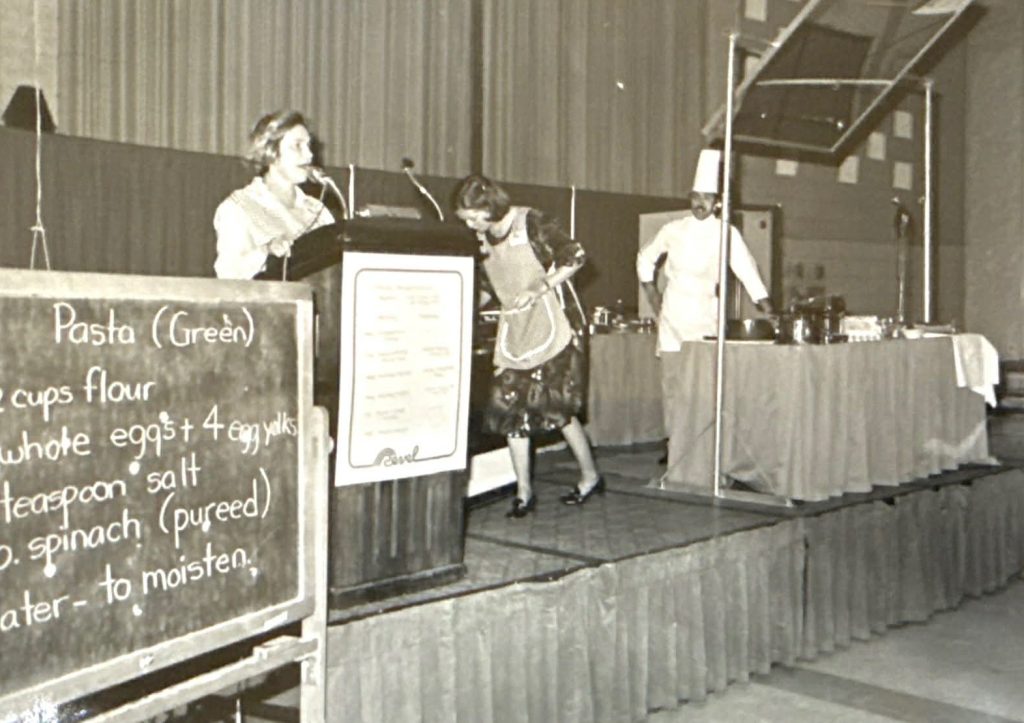
Between 1976 and 1980, the Revel quickly established cooking demonstrations as one of the festival’s main draws. In the first few years, a who’s who of Shreveport chefs marched onto the elaborate cooking stage and demonstrated how to prepare some of their signature dishes.
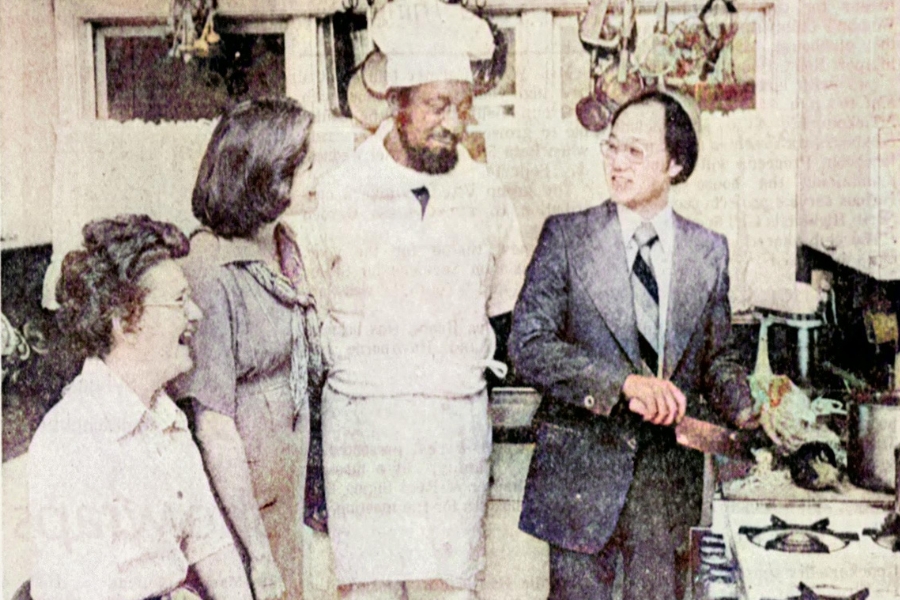
Shorty Lenard, famous for his Black Forest cakes, taught a lecture on cooking something called “Trout a la Joan of Arc.” Ernest Palmisano prepared jumbo fried shrimp (“Don’t let ‘em dance on top of the oil!,” Palmisano warned the crowd). While dressed in a suit, restaurateur Check Wing Joe, owner of Polynesian restaurant Kon-Tiki, demonstrated how to weild a Chinese cleaver. Abe Ritman, the first restaurateur to market boiled crawfish in Shreveport, cooked crawfish etouffee. Shirley Faludi, an Austrian opera singer and the author of a popular Shreveport cookbook, belted out German arias while pounding a pile of dough.
It sounds like a freakin’ blast.
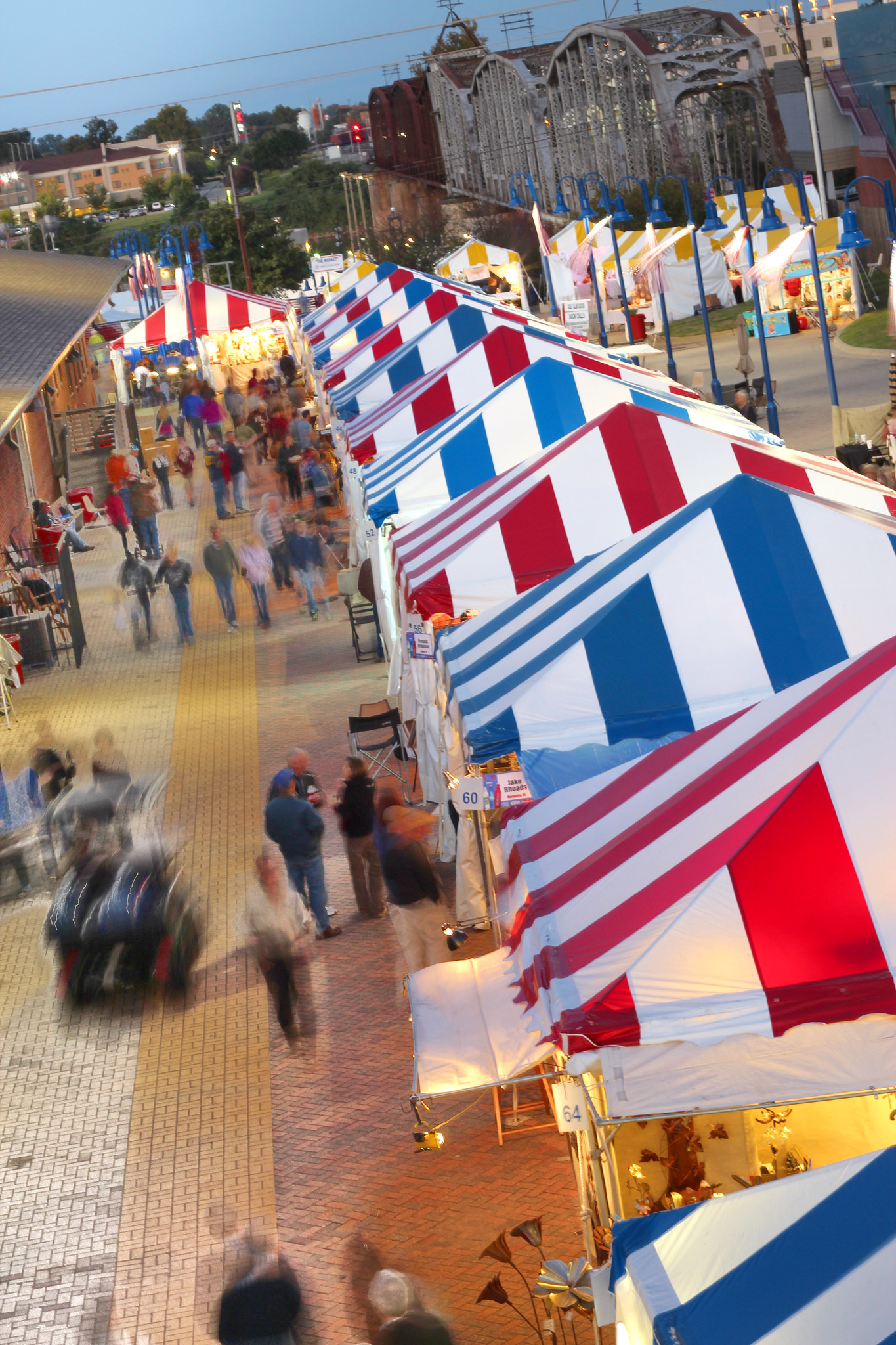
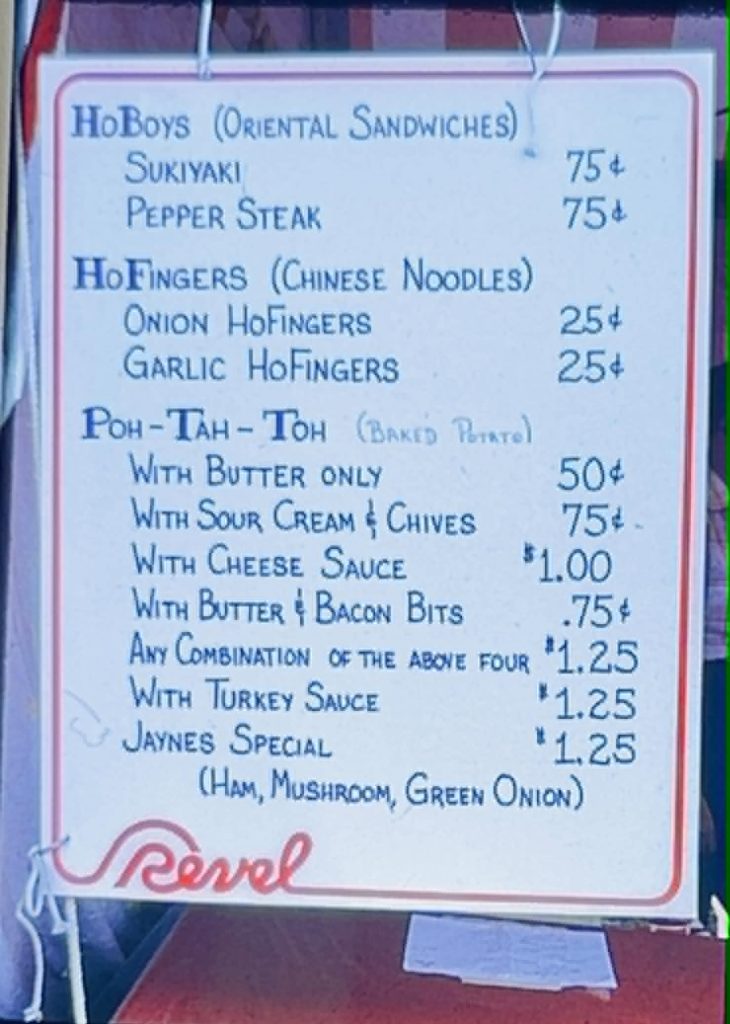
Just down Clyde Fant Parkway from the Convention Hall, the vendors who were selected to serve food also reflected an intentional, multicultural approach to concessions that saw food options as an extension of the fest’s culinary programming. The Council of Jewish Women operated a kosher food booth that sold lox and bagels. The Allendale YWCA sold homemade chicken and dumplings, black eyed peas, and peach cobbler. A group called The Daughters of Penelope operated a Greek food booth where they sold loukoumades (Greek doughnuts). A booth selling something called Sukiyaki Ho Boys (described as “Chinese sandwiches” in advertisements) was apparently the breakout hit of the first few years.
While I was reading over programs and advertisements, it occurred to me that none of this happened by accident. It wasn’t only good timing that brought this incredible lineup of local cooks to the Revel stage—it was also the result of intentional, thoughtful work on behalf of the fest’s all-volunteer food committee.
One of those volunteers was restaurateur Joe Fertitta. In numerous articles, he is referenced, along with others, including Marion Weiss, Betty Arceneaux, Betty E. Wiener, Carolyn Flournoy, and Mimi Hussey, as having been instrumental in planning the festival’s culinary offerings for the first few years.
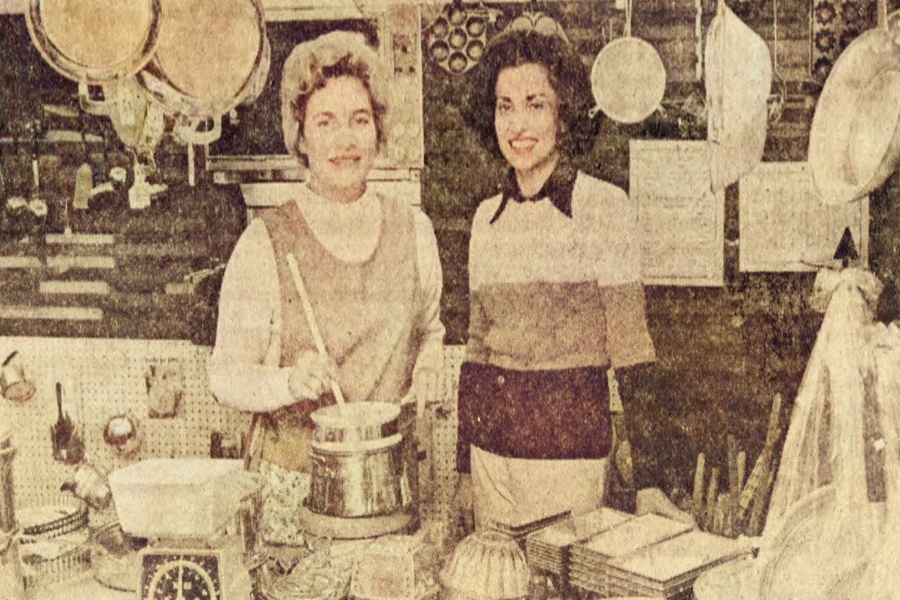
“When we got rolling, we didn’t have a true, big, planned agenda,” Fertitta recalled. “We knew that we wanted it to be arts-oriented—food as art. There were a number of ladies who were board members and contributing brains. They had ideas for where they wanted it to go. For little bitty women, they swung an axe faster than I did, I guarantee you that. They were organized people, they were civically active, and I still love them to death.”
Fertitta said that one reason why the cooking demonstrations were such a big production during the Revel’s early years was because they had tremendous sponsorship support. Big groups like SWEPCO and Arkla Gas, which had an interest in promoting home cooking, stepped up to finance the elaborate cooking demo stage. It was a true festival stage, with top-of-the-line commercial ranges and ovens as well as mirrors mounted above the cooking space so that the crowd could follow along as the chefs worked.
“We had facilities that were nice, and we kind of took over the Convention Center downtown; it was new and beautiful and clean,” Fertitta said.
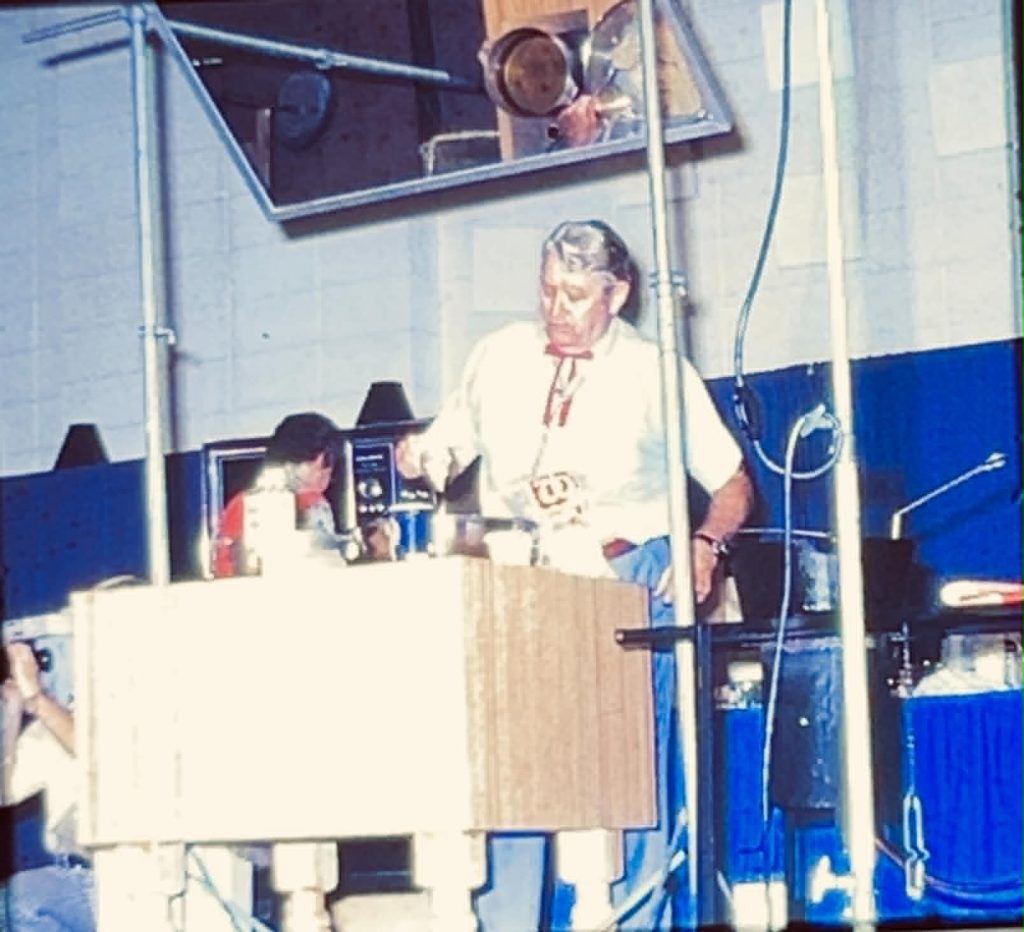
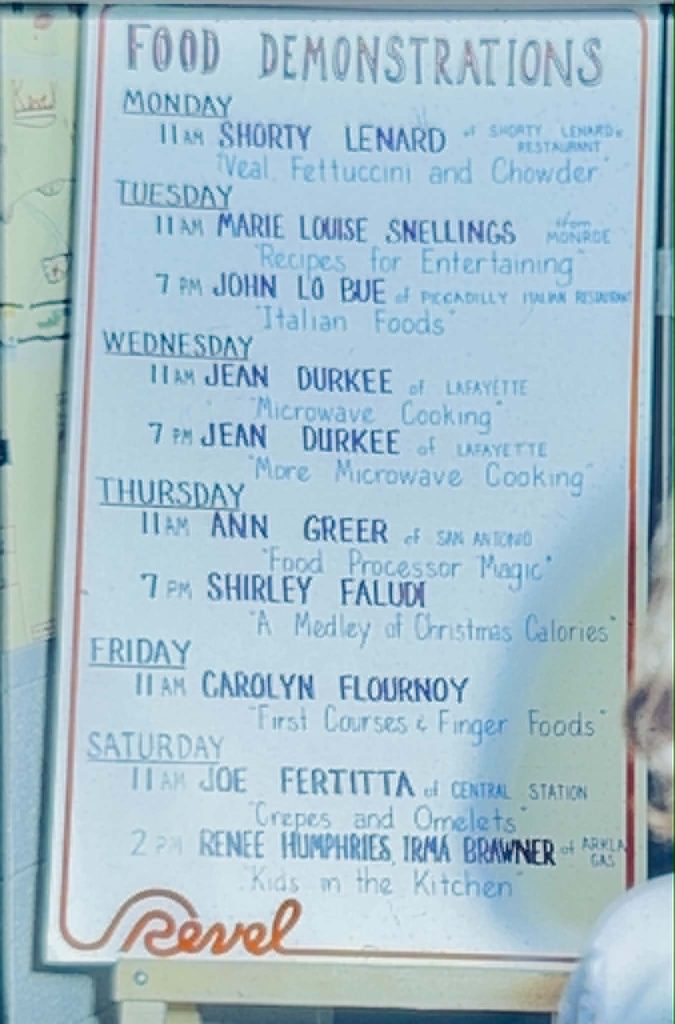
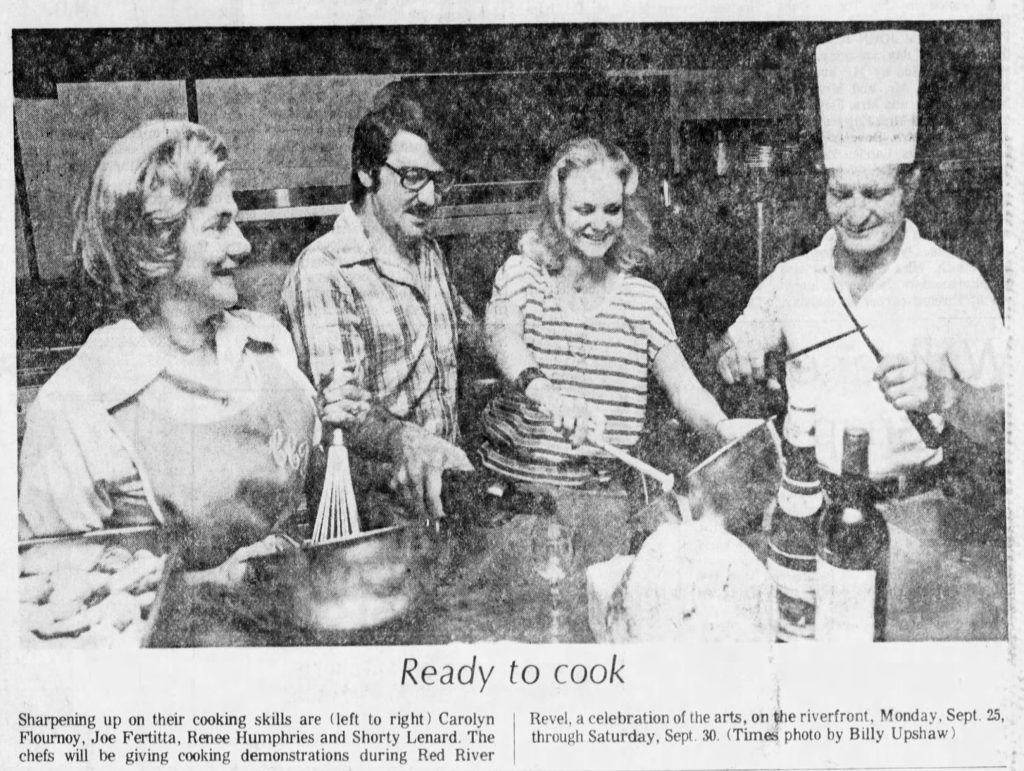
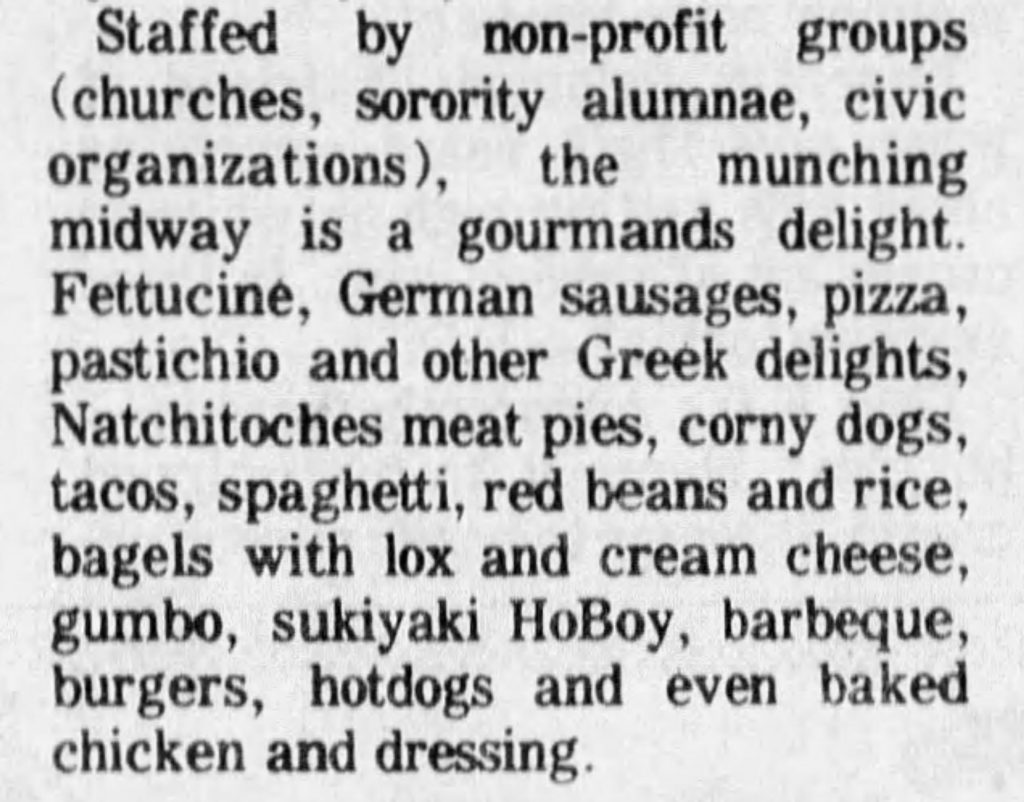
Another factor that encouraged the Revel’s food committee to celebrate local chefs was the enthusiastic support of The Shreveport Times’ food columnists, Carolyn Flournoy and Marilee Harter. As Revel season approached, Flournoy and Harter would begin publishing a steady stream of articles about local chefs who would be hosting demos. Week after week, they previewed the Revel’s culinary offerings and lifted up local chefs for celebration.
“Once again demonstrations by renowned area chefs will be given the same attention as concerts, potters and painters and weavers at work, lectures by literary lions, and film seminars,” Flournoy wrote in 1978. “Cooking is indeed a learning experience, both a visual and consummate art.”
Not all of the cooking demos were led by locals. As early as the second year, the Revel’s food committee began to host chefs from nearby cities—as well as the occasional celeb, like chef and comedian Justin Wilson, who taught a Cajun cooking class in 1978—while adding more and more top-tier local talent, including Giuseppe Brucia, to the list of featured locals.
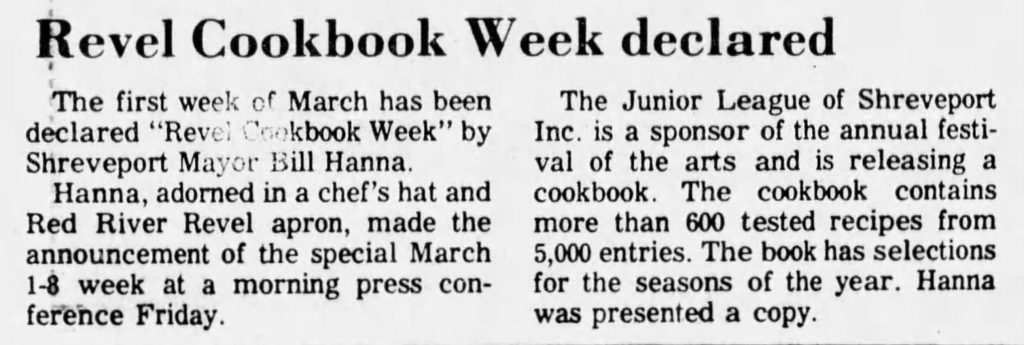
The early energy surrounding the culinary arts at the Revel peaked in 1980, with the release of the Junior League’s Revel cookbook, which ranks among the best-known of all Shreveport cookbooks. Shreveport Mayor Bill Hanna officially declared the first week of March 1980 to be “Revel Cookbook Week,” and the mayor was given the first printed copy of the book. It was an immediate hit, and, to date, has sold more than 50,000 copies.
The overwhelming support and interest that all of this received from the public is mind-boggling. I imagine throngs of people packing into the convention hall to see Check Wing Joe dismantle a hen with two thuds of his cleaver and I marvel at the unlikelihood of it all.
The culinary programs of the Revel in its infancy caught Shreveport lightning in a bottle in a way that could never be reproduced. The cast of characters made it so. These were chefs who’d emigrated to America from all over the world, who’d introduced Continental Cuisine to Shreveport consumers, and whose outsized personalities made them legends in their own time.
“These were all my contemporaries, but I also saw them as godfathers,” Fertitta said. “Jimmy Joe from Bamboo, Ernest Palmisano, Dietmar Molitor, Check Wing Joe…we had a very competitive, but friendly, restaurant group in Shreveport. We were all striving to put Shreveport on the map. We were kind of the outlaws.”
The chefs who were placed in the spotlight during the Revel’s first few years were a brilliant, diverse, eccentric group. I tried several times to get Fertitta to gossip about them or share memories from backstage during the cooking demos. But, each time I asked about the eccentric group of chefs who were involved in the early years of the Revel, Fertitta re-routed the question to honor his old friends.
“I feel privileged to have known these people—they left a legacy,” he said.
The legacies of those chefs, and many others like them, would be much more difficult to track down were it not for the efforts of Revel organizers, volunteers, and sponsors in the early years, whose work shone a spotlight on a tremendous cohort of chefs from around the world who’d somehow come to rest in Shreveport during the mid-twentieth century. The stars aligned for those first few Revels, and, as a result, some of the most interesting figures in Shreveport’s culinary history emerged as Shreveport’s first class of “celebrity chefs.”
The 50th Red River Revel Arts Festival will be held, Oct. 8-11 and 15-18, 2026, in downtown Shreveport’s Festival Plaza. Check out their website or follow the festival on Facebook for updates as they are announced.